
How Doodling Boosts Creativity in Kids and Teens: 6 Ways Silly Sketches Build Real Skills
How Doodling Boosts Creativity in Kids and Teens: 6 Ways Silly Sketches Build Real Skills
Parents and teachers often see doodling as a distraction. A kid scribbling monsters in the margin of their notebook? Must be bored. A teenager filling a page with wacky buildings and goofy food characters? Probably not paying attention.
But here is the truth: doodling is one of the most powerful creativity-building activities a young person can do. Research in cognitive science shows that doodling activates areas of the brain involved in problem-solving, memory, and creative thinking. It is not a sign of a wandering mind. It is a sign of a brain that is actively processing and creating.
The best part? Different types of doodles exercise different creative muscles. Let us look at six doodle styles that build real skills in kids and teens.
1. Silly Creatures and Monsters: Imagination Without Rules
A page packed with dozens of goofy monsters, all different sizes and shapes, all crammed together in a chaotic pile. Some are upside down. Some have three eyes. One is eating another one's hat. There are no rules here, and that is exactly the point.
When kids color or draw silly creature pages, they learn that creativity has no wrong answers. A monster can be purple with polka dots and seven legs. A blob creature can have a tiny hat and a huge grin. The wilder the better.
This kind of unstructured creative play is essential for building what psychologists call "divergent thinking," the ability to generate many different ideas from a single starting point. Kids who practice divergent thinking become better at brainstorming, problem-solving, and thinking outside the box in every area of life.
The variety matters too. When creatures on the page come in dramatically different sizes and shapes, some huge and some tiny, some round and some spiky, kids absorb the idea that variety is interesting and that differences make things more fun, not less.
2. Food Frenzy Doodles: Storytelling Through Everyday Objects
Give a donut a pair of eyes and a goofy smile, and suddenly it has a personality. Stack a bunch of food characters together (a grumpy taco, a sleepy ice cream cone, a hyperactive pizza slice) and kids naturally start building stories. Who are these characters? What are they doing? Why is the cupcake laughing at the hot dog?
This is personification, and it is one of the most powerful creative tools in art and writing. When kids practice turning everyday objects into characters, they are building the same storytelling muscles used by authors, animators, and game designers.
Food doodles are especially effective because every kid has a relationship with food. They already have opinions about pizza versus broccoli, and those opinions become fuel for creative expression. A child who "does not like drawing" will happily color a page of silly food characters because the subject feels familiar and fun.
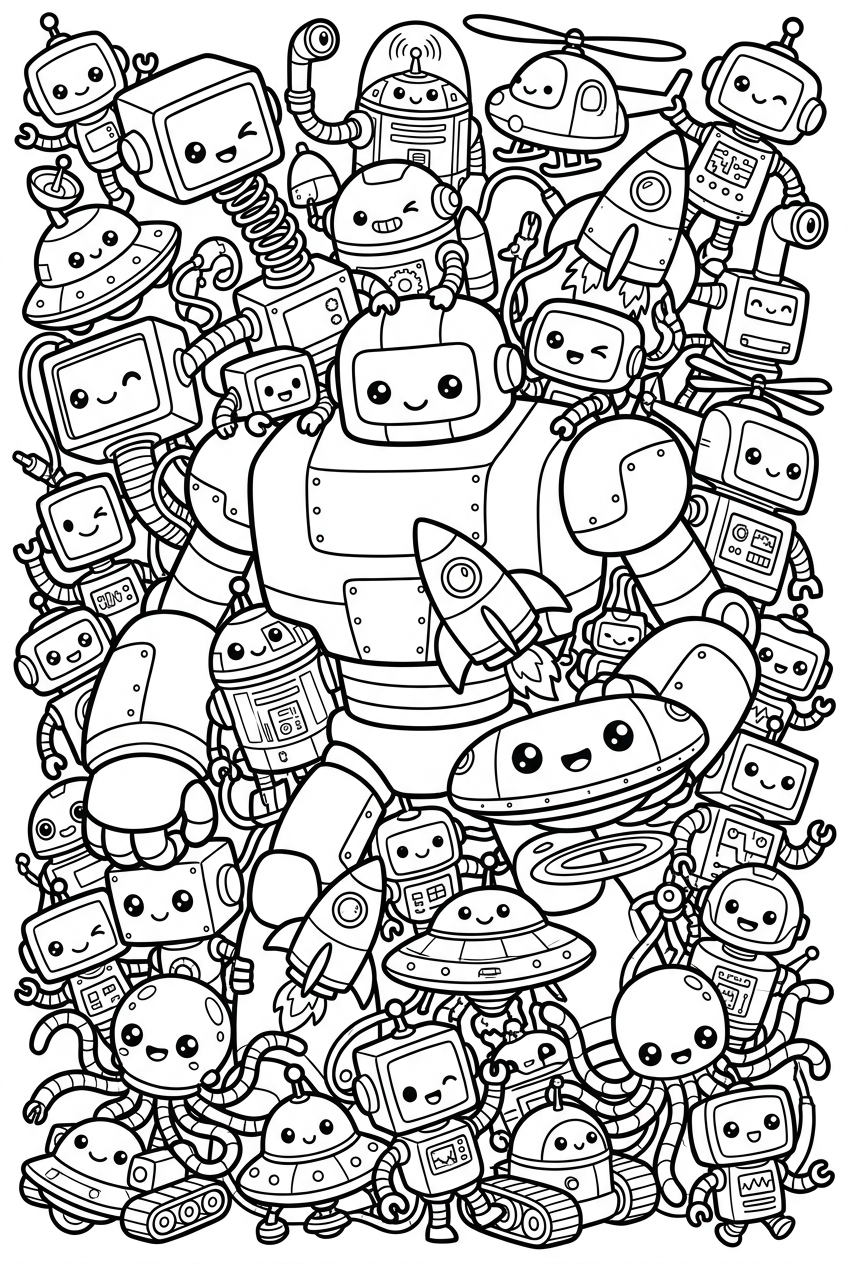
3. Robot Party: Blending Logic and Creativity
Robots are the perfect gateway for kids who think they are not creative. Many children, especially those who lean toward math and science, feel intimidated by freeform art. But robots? Robots have buttons, gears, screens, and antennae. They feel structured and logical, which makes them approachable.
Here is the secret: designing a robot is just as creative as drawing a dragon. What kind of eyes does your robot have? LED screens with heart emojis? Giant radar dishes? A cracked display showing an error message? These choices are pure creative decision-making, wrapped in a package that feels safe and logical.
Robot doodle pages also naturally bridge STEM and art interests. A kid who loves coding and engineering can express that passion through robot character design. This crossover between technical thinking and artistic expression is exactly what modern education calls "STEAM" (Science, Technology, Engineering, Art, and Math), and it happens naturally when a kid is coloring a page of wacky robots.
4. Mushroom Forest: Building Imaginary Worlds
Mushroom forest doodles combine magical mushrooms with tiny forest creatures like snails, frogs, caterpillars, and ladybugs, all packed together in a dense, enchanted scene. This style encourages something powerful: world-building.
When kids engage with fantasy environments, they are not just coloring shapes. They are imagining a place. What lives here? What are the rules of this world? Why is that giant mushroom glowing? Why is the tiny frog wearing glasses?
World-building is the foundation of creative writing, game design, filmmaking, and animation. Kids who practice imagining detailed environments develop the ability to hold complex creative ideas in their minds and expand on them. A mushroom forest coloring page today can become an original story, a video game concept, or an art series tomorrow.
The mix of different character types (plants and animals living together) also teaches composition. Kids learn to see how different elements interact and relate to each other within a shared space.
5. Doodle City: Architecture of Imagination
Buildings with window-eyes and door-mouths. Skyscrapers leaning sideways. A lighthouse shining its beam across tiny houses. Doodle city pages take something structured and orderly (architecture) and make it playful and expressive.
This style is brilliant for developing spatial thinking. Kids must consider how buildings fit together, how small ones relate to large ones, and how a scene builds from individual parts. These skills transfer directly to math, engineering, and design.
But the real magic is in the imperfection. Doodle city buildings are wonky, crooked, and tilted at silly angles. This teaches kids that creative expression matters more than technical perfection. A building does not need straight lines to be interesting. In fact, the crooked ones are often the most fun.
For teens especially, doodle city pages can spark interest in urban design, graphic novels, and illustration. The style is sophisticated enough to feel cool, but playful enough to stay fun.
6. Why Variety Matters: Rotating Doodle Styles Prevents Creative Ruts
Here is something most parents and teachers do not realize: doing the same type of creative activity over and over actually limits creativity. If a child only ever colors princess pages or only draws cars, their creative muscles get stuck in a pattern.
Switching between different doodle styles is like cross-training for the brain. Silly creatures build wild imagination. Food doodles build storytelling. Robots build logical-creative thinking. Mushroom forests build world-building. Doodle cities build spatial awareness.
When kids rotate between these styles, they develop a broader creative toolkit. They become comfortable with different types of visual thinking and learn to approach problems from multiple angles. This flexibility is exactly what employers, universities, and creative professionals look for.
The challenge for parents has always been keeping a fresh supply of varied, interesting coloring pages. Traditional coloring books run out, and finding high-quality printable pages online takes time. This is where AI-powered tools change the game.
Give Your Kids an Unlimited Creative Playground
With DoodleAI, you can generate an endless variety of doodle coloring pages in seconds. Choose from Silly Creatures, Food Frenzy, Robot Party, Mushroom Forest, Doodle City, and dozens more styles. Every page is unique, so your kids always have something fresh to spark their imagination.
Whether your child is 5 or 15, there is a doodle style that will click with their interests and stretch their creative thinking. The best part? It takes just 2 clicks to generate a new page.
Start Creating Doodle Coloring Pages Now ->
Browse our free coloring page gallery for ready-to-print doodle designs, or create your own with the AI generator. Your kids' creativity will thank you.